

CASE STUDY: SELLING B2B... ACTIVELY
Actively's $45MM Raise Shows the Value of Latent Data

EDITOR’S NOTE
As the former head of data for large ad firms, I’ve been on countless client calls with sellers who… I mean, some of them… while perky, and great at securing a bagel platter… never seemed to have it occur them to do deep research about their clients. This pained me. It was like: these clients have such interesting businesses. You’re really going to walk in there and ask for money, armed only with the knowledge of what they bought from you last quarter? I should be more sympathetic, I know: every Account Exec carries a big book, they’re under pressure, they have all that nasty Salesforce logging to do. Yet it always felt like: this could be done better. Maybe a lot better. And when I think back to the scale of this operation… scores of sellers in so many markets… it feels like a huge gap.
The company Actively has what may be an elegant solution: tying together the data that already exists in a B2B organization into an intelligence tool for B2B salespeople, to make them more effective. Not replace them with a bot, but give them cyborg powers to expand and extend what they can accomplish.*
(*This “it’s not X it’s Y” sentence was written by a human.)
A startup I met recently claimed to have 50,000 AI agents--fifty thousand!--scurrying around the web like ants gathering data. Actively raised $45 million last month so that in your sales org, every account can get its own AI agent.
What does that agent do? It supports one account around the clock. The agent reads the call notes from past reps; scans the web for buying triggers—a funding round, a job change, a product launch. It decides who the AE (or sales development rep) should call, and why. It drafts the email. Then it hands the work to a human seller in the morning.
A couple things I like about this, as a case study for you:
1 - The data… the account history, the stakeholder map of the client, the Gong call transcripts… already belongs to the company. The company is just not getting value from it. Yet. It’s what we call, latent data. So Actively is sweeping in and creating value from pre-existing assets.
2 - This is also an important example of the fine line startups must play in the world of AI business models, especially ones that involve activating a client’s own data. What’s to stop the client from crafting its own homegrown tool that does this exact thing? (Some B2B sales companies are doing just that, with internal IT or product teams.) This is a live test! How fast can Actively turn the innovation crank handle, develop more features and more scope, and bring in exclusive data, to stay ahead of competitors, client DIY, and vertical integration from Big Tech?
Why are they chasing it, then? Actively’s argument is that Sales is the most expensive function in a B2B company: thirty to forty cents of every dollar of revenue at a B2B company goes back into go-to-market. Sales engagement tools are tricky to size as a space—CRM is $70B+ depending on estimates—but the vision seems to be that there’s an opportunity for somebody to be the Cursor (coders) or Harvey (lawyers) for B2B sellers. Cyborg tools for knowledge workers.
Other players have made the same observation. 11x.ai sells “Alice,” an AI account exec (reported $350 million valuation). Artisan runs “Ava” and put up “Stop Hiring Humans” billboards along SF highways. Qualified has “Piper.” Clay, Apollo, Outreach, Amplemarket, and Regie.ai compete in adjacent slices—data enrichment, outbound automation, and dialers.
So what’s their angle?
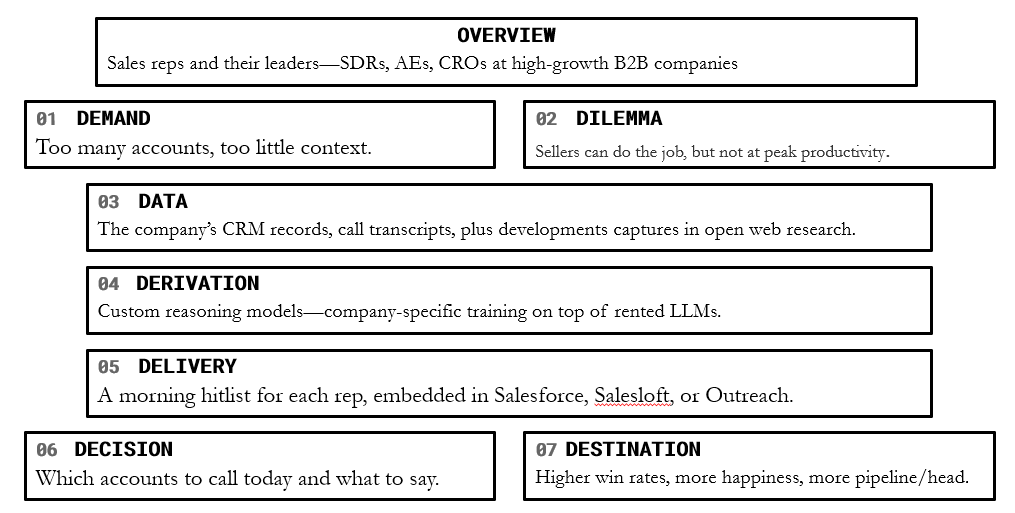
Actively’s 7Ds of Data Innovation:
Demand. Sales reps and their leaders—SDRs, AEs, CROs at high-growth B2B companies
Dilemma. Too many accounts, too little context, too much manual research (or none at all sometimes).
Data. The company’s own CRM records, call transcripts, product usage, intent signals, and whatever is on the open web, combined into a single data set to train the agent.
Derivation. Custom reasoning models—company-specific fine-tunes built on top of rented LLMs.
Delivery. A morning hitlist for each rep, embedded in Salesforce, Salesloft, or Outreach.
Decision. Which accounts to call today and what to say.
Destination. Higher win rates, less burnout, more pipeline per head
COMPANY OVERVIEW
Actively builds AI agents for B2B sales teams. The product assigns one agent to every account in the customer’s market. The agents run in parallel. Each one builds a memory of what is happening inside its one account. They recommend who to call, they draft the message, and then queue up the work for human sellers and managers.
Date of Founding: 2022.
CEO Profile
Mihir Garimella is in his early twenties. He grew up in Pittsburgh and went to Stanford for both undergrad and graduate work in artificial intelligence. At fourteen he won the top prize in his age category at the Google Science Fair for “Flybot,” a tiny emergency-response drone inspired by how fruit flies dodge swatters (!). CNN profiled him as one of “tomorrow’s heroes.” Co-Founder Anshul Gupta is the other founder and runs the revenue side of the company. He has a master’s in computer science (AI) from Stanford and was a research peer of Garimella’s.
Founding Story
The two met at Stanford. They watched ChatGPT change the AI world in 2022 and 2023 and started asking: which corporate function spends the most money and has the worst AI tooling? They chose sales. A seller with 200 accounts can only seriously focus on a handful in any given week. The other 195 sit dormant. Garimella and Gupta thought reasoning-based AI agents could change that.
Total Investment Raised to Date: $68 million.
Seed: $5M, led by First Round Capital.
Series A: $17.5M in April 2025, led by Bain Capital Ventures.
Series B: $45M in April 2026, co-led by TCV and First Harmonic. Bain Capital Ventures, First Round, and Alkeon joined. $250M post-money valuation.
What the Company Does
For each customer, Actively builds custom AI agents that read everything the customer knows about each account—Salesforce records, Gong call recordings, Outreach emails, marketing-automation behavior, intent data from tools like 6sense, plus public web signals like a new funding round. The agents reason over that material and decide which accounts are worth calling today, who to contact, why now, and what to say. The output lands in the rep’s existing workflow.
How the Company Makes Money
Annual enterprise subscriptions. Pricing is not public. Third-party comparisons of competing AI sales platforms put enterprise contracts in this segment between $30,000 a year and the high six figures, depending on seat count and integrations. Actively targets the high end—companies with dozens of SDRs, hundreds of AEs, and complex sales.
Top Named Clients
Company-sourced: Ramp (corporate cards), Samsara (connected operations hardware), Ironclad (contract management software), Greenhouse (recruiting software), Justworks (HR for small businesses), Verkada (security cameras), Attentive (SMS marketing), Navan (corporate travel). Samsara is the biggest deployment: 1,000 people across sales, account development, RevOps, and customer success.
1. DEMAND
Who is their user?
Priority User 1: The Sales Development Rep (SDR)
The SDR is the entry-level role in B2B sales. Twenty-something. First or second job out of school. Sits in a noisy bullpen and works the phones. Compensation is mostly tied to “meetings booked”—convincing a stranger at a target company to sit on a 30-minute call with an account executive.
The classic SDR day:
- 8am. Dig through Salesforce notes and LinkedIn for 50 companies to email.
- Late morning. Fire off 100 emails.
- Afternoon. Make 50 cold calls.
- Evening. Log everything in Salesforce.
I’ve never worked in an org with this role, but the general take seems to be: it’s a burnout role because you churn and churn and don’t see the results of your work, and don’t see a goal, or an end in sight.
Priority User 2: The Account Executive (AE)
The AE is the next rung up. They own the revenue target. They take the meetings the SDR booked, run discovery calls, write the proposal, negotiate, and close. At fast-growing B2B companies a full-cycle AE is also expected to source pipeline too.
Priority User 3: The Chief Revenue Officer (CRO)
A 2025 GTM benchmarks report found that 63% of CROs have little or no confidence in how their Ideal Customer Profile is defined. Yikes. (We see that too, at the DataStory Group.) The executive on the hook for hundreds of millions in revenue often does not trust the definition of “who do we sell to” coming out of their own marketing team.
2. DILEMMA
What makes achieving that goal difficult?
Obstacles for the SDR
A modern SDR is given 200 to 500 accounts in a territory. Cold-call response rates run well under 5%. Even the best SDRs convert only a small fraction of their outreach to booked meetings. High volume plus high rejection equals exhaustion and a feeling of pointlessness.
Obstacles for the AE
The AE has too few accounts but too much context to keep straight inside each one. A typical enterprise deal can run six to twelve months, requiring input from ten stakeholders. When an AE inherits an account from a departed colleague, that context disappears.
Obstacles for the CRO
The CRO is responsible for fixing all the dynamics above, which can make them feel more like a data engineer—SF, Gong, notes, metrics, reports, KPIs—than the sales strategy leader they signed up to be.
3. DATA
What data can be accessed to achieve the goal?
Actively does not own a proprietary outside dataset. The data lives inside the client’s own tools. There are four main types.
Data Type 1: CRM Records.
The CRM is the system of record for the sales team. It stores every account, contact, deal, interaction the company logs.
Data Type 2: Conversation Data.
Sales calls have been getting recorded and transcribed for about a decade. Gong is the dominant tool; there’s also Chorus, Clari, and Avoma. Every customer call becomes a transcript which is a potential goldmine where the client expresses their needs, competitor stresses, and budget issues.
Data Type 3: Intent and Engagement Signals.
These are signals from third-party data providers that try to predict when a company is about to buy. The biggest is 6sense. They aggregate anonymous web behavior—what blogs are being read from which corporate IP ranges, what comparison pages are getting traffic—to flag accounts that look “in market.” Marketing-automation tools like Marketo and HubSpot add: who filled out a form, attended a webinar, downloaded a whitepaper. Also there’s the public web—funding rounds, big client wins, executive hires, layoffs, mergers, product launches, press coverage.
Data Type 4: Internal Enablement Material.
Most B2B companies keep a library of internal sales materials—how to position against each competitor, talk tracks for each persona, case studies, pricing playbooks. This usually lives in Notion, Confluence, or Highspot.
4. DERIVATION
How do analytics and AI make the data usable?
Layer 1: Custom Reasoning Models.
For each client, the team builds a custom model that combines off-the-shelf reasoning models from OpenAI and Anthropic, trained on the data above.
Layer 2: Per-Account Memory.
The second layer is the context for the agent. Actively assigns one persistent agent per account. That agent’s memory updates whenever something new happens—a new call recorded, an email opened, a free-trial signup. The memory persists across AE changes, and territory reassignments.
Layer 3: Multi-Agent Execution.
Once the memory and the model are in place, agents move into execution: research, prioritization, contact selection, message drafting, and finally a hand-off to a human seller or to an automated sequence in Salesloft or Outreach.
5. DELIVERY
How does the workflow improve for the user?
Actively’s interface sits inside the tools sellers use—Salesforce, Outreach, Salesloft, Gong—and inside a web app called the Agent Inbox. SDRs get a queue of priority prospects.
The AE gets a daily meeting-prep digest before calls: account summary, recent news, suggested talking points, last-touch history.
The CRO gets a dashboard: which accounts are stalling, win rate trends.
6. DECISION
What decision is enabled by using the data?
Decision 1: Which accounts to work on today
In a 500-account territory, an SDR can only seriously work twenty or thirty in a day. Picking the right twenty is a high value decision in the SDR’s workflow.
Decision 2: Who at the account to contact?
Inside any large account there are dozens of plausible buyers. Those agents help choose based on who has been mentioned in past calls, who responded to past marketing emails, who recently changed jobs--then recommends a primary contact.
Decision 3: How to allocate sales investment?
For the CRO, the question is “can my existing reps cover more accounts with the same effort?” to deliver more pipeline with flat headcount. A classic optimization challenge--match your supply to your available demand.
7. DESTINATION
What does success look like?
Sales is a great area for data-driven insights--because you can test them. Give a seller a toolkit conferring cyborg superpowers, and you should be able to see the results show up immediately: in higher win rates, more senior relationships, bigger budgets per relationship. In short, higher productivity.
And, one would think, higher happiness in the sales team. If you can show up at work and just be an athlete… not carry the Gatorade and launder the uniforms… and not only that, have a robot voice in your head telling you where to run on the field… why am I talking in these extended sports metaphors?... that feels like a major win.
8. SOURCES
COMPANY SOURCES
1. Actively, “Intelligence-Led Revenue,” April 20, 2026. https://www.actively.ai/blog/intelligence-led-revenue
2. Actively company website. https://www.actively.ai/
3. Actively, Customers page. https://www.actively.ai/customers
4. Actively, Samsara customer story. https://www.actively.ai/customers/samsara
5. Actively, Justworks customer story. https://www.actively.ai/customers/justworks
6. Actively, Ironclad customer story. https://www.actively.ai/customers/ironclad
7. Actively, SDR solutions page. https://www.actively.ai/solutions/sdr
8. Mihir Garimella, personal website. https://mihir.garimella.io/
9. Mihir Garimella LinkedIn. https://www.linkedin.com/in/mgarimella/
10. Anshul Gupta LinkedIn. https://www.linkedin.com/in/agupta24/
FUNDING & THIRD-PARTY PRESS
11. BusinessWire, “Actively Raises $45M Series B,” April 28, 2026. https://www.businesswire.com/news/home/20260428810008/en/Actively-Raises-$45M-Series-B-to-Scale-Intelligence-Led-Revenue-Platform
12. Pulse 2.0 (Amit Chowdhry), Series B coverage, April 29, 2026. https://pulse2.com/actively-45-million-raised-to-scale-intelligence-led-revenue-platform-powered-by-per-account-ai-agents/
13. Sofia Chierchio, “Meet The $250 Million Startup Challenging Salesforce With AI Agents,” Forbes, April 28, 2026. https://www.forbes.com/sites/sofiachierchio/2026/04/28/meet-the-250-million-startup-challenging-salesforce-with-ai-agents/
14. Charles Rollet, “Actively AI raises $22.5M to offer sales ‘superintelligence,’ says AI SDRs failed,” TechCrunch, April 2, 2025. https://techcrunch.com/2025/04/02/actively-ai-raises-22-5m-to-offer-sales-superintelligence-says-ai-sdrs-failed/
15. BusinessWire, Series A coverage, April 1, 2025. https://www.businesswire.com/news/home/20250401198986/en/Actively-AI-Raises-$22.5M-to-Maximize-Revenue-for-Top-Sales-Teams-with-GTM-Superintelligence
16. Bain Capital Ventures, “Actively AI is Launching a New Era of GTM Superintelligence,” April 2, 2025. https://baincapitalventures.com/insight/actively-ai-is-launching-a-new-era-of-gtm-superintelligence/
FOUNDER PROFILES
17. CNN Business, “Mihir Garimella is making drones that go where humans can’t,” February 8, 2018. https://www.cnn.com/2018/02/08/tech/mihir-garimella-drones-tomorrows-hero/index.html
18. Singularity Hub profile of Mihir Garimella, August 25, 2017. https://singularityhub.com/2017/08/25/this-inspiring-teenager-wants-to-save-lives-with-his-flying-robots/
19. The GTM Engineer (Substack), interview with Anshul Gupta. https://thegtmengineer.substack.com/p/the-account-as-a-unit-and-finding
20. Orum Podcast, “Anshul Gupta on AI and tryin’ to triage.” https://www.orum.com/podcasts/anshul-gupta
COMPETITORS & AI-SDR LANDSCAPE
21. TechCrunch, “AI SDR startups are booming, so why are VCs wary?” December 26, 2024. https://techcrunch.com/2024/12/26/ai-sdr-startups-are-booming-so-why-are-vcs-wary/
22. TechCrunch, “A16z- and Benchmark-backed 11x has been claiming customers it doesn’t have,” March 24, 2025. https://techcrunch.com/2025/03/24/a16z-and-benchmark-backed-11x-has-been-claiming-customers-it-doesnt-have/
23. Artisan AI “Stop Hiring Humans” campaign. https://www.artisan.co/blog/stop-hiring-humans
24. Qualified AI SDR (Piper) product page. https://www.qualified.com/ai-sdr
25. 11x.ai company website. https://www.11x.ai/
MARKET SIZING & CONTEXT
26. Market Growth Reports, Sales Engagement Platform Market Size Report. https://www.marketgrowthreports.com/market-reports/sales-engagement-platform-market-118278
27. Lusha, “Why Outbound Sales Development Reps Burn Out in 15 Months.” https://www.lusha.com/blog/outbound-sales-rep-burnout-causes/
28. Sales Gravy, “Why Your Best SDRs Burn Out by Month Four.” https://salesgravy.com/why-your-best-sdrs-burn-out-by-month-four-and-how-to-stop-it/
29. Orum, “How Sales Leaders Can Fight SDR Burnout.” https://www.orum.com/blog/fight-sdr-burnout
30. Fullcast, “RevOps for CROs.” https://www.fullcast.com/content/revops-for-cros/
COMPANY PROFILES
31. PitchBook, Actively AI 2026 Company Profile. https://pitchbook.com/profiles/company/172150-84
32. Actively LinkedIn company page. https://www.linkedin.com/company/actively-ai/