

CASE STUDY: WHOOP
A $10B Wearables Valuation Gets Our Pulses Pounding About Biometrics

As we do each month, we offer a case study about a company that’s raised major funding, to see what cutting-edge tactics you can learn from using our “7Ds” framework. This month we profile WHOOP, the sports wearable company which raised $575 million in March at a $10.1 billion valuation. Maybe it’s a strange choice for The DataStory: it’s B2C; and here at the DataStory, we are not athletes. But WHOOP reveals why biometrics are fascinating.
BIOMETRICS BEDAZZLE US
In biometrics the journey from raw reality (my pulse) to metrics (my heart rate variability, or HRV) to action (“Justin, you have AFib and need to see a doctor”) is stark, vivid, and kind of strange—the measurement is not out there in some grocery store; it’s happening right there on my wrist and my chest.
Second, by stepping outside our usual frameworks—about say financial or sales data—biometrics in general, and WHOOP in particular, remind us of several important principles:
The importance of passive measurement. The biometrics industry’s central insight is that the richest signal comes from continuous, unobtrusive collection. No friction. Compare that to altrenatives for healthcare data collection: episodic at best, and requiring the patient to show up and get stuck with a needle. In your business this is the equivalent of purchase data, browsing patterns, dwell times, and product use--all passive signal where the customer “votes with their feet” and doesn’t filter or add response bias.
The value of data-gathering infrastructure. Over time WHOOP claims to have gathered 24 billion hours of physiological data. That’s an asset, a moat, and an attraction for strategic investors Abbott Labs and the Mayo Clinic.
The gap between metrics and diagnosis. In biometrics, you can gather a signal (HRV), you can even interpret into a score (“Strain”)… but to make a diagnosis, now you need FDA approval. Thematically we see that with many AI companies that use metrics to surface events that require attention—and draw humans into the loop.
The gap between population and individual-level decisions. Most medical inferences come from population studies. The leap from “in a population of 100,000 people, this signal correlates with this condition” to “your specific reading means you have this condition” is pretty vast. This is true in nearly every analytics-driven business scenario. Your churn model is right about the population; it’s less right about any individual customer. Your employee engagement survey reflects something true at the org level; it tells you much less about a specific person or team. To leave that gap is to leave a lot of value on the table—measured in revenue and profit in one world, in healthy vs. sick people in this one.
THE BODY AS DATA
Zooming back in on biometrics, it’s fascinating to think about the body as a zone of measurement opportunities. I walked the floor of CES with a healthcare executive who told me their company was looking at gait as a signal for serious conditions. I didn’t get it at the time. Now I do. We created this (selective) table to show the scope of what’s happening out there in biometrics:
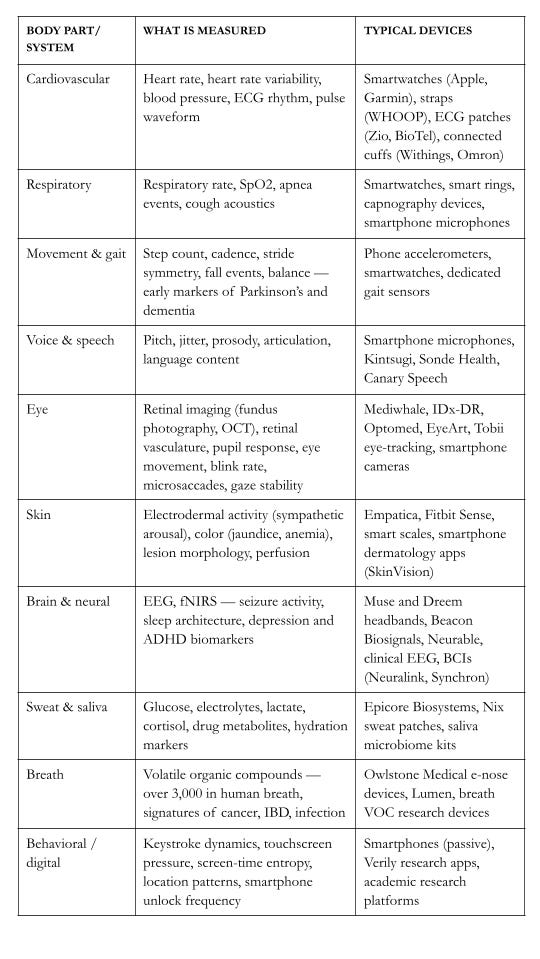
With all this data being gathered, these physical systems are becoming legible to algorithms in a way that’s—needless to say—unprecedented in our history.
RACING PULSE
This is happening fast, and gaining speed, right now. Apple Watch and Fitbit irregular-rhythm notifications constitute a massive largest cardiac screening deployment. In 2024, my alma mater Samsung, and Apple, both received FDA clearance to detect sleep apnea from the wrist. The FDA cleared the first OTC continuous glucose monitor that same March. Apple put a clinical-grade hearing aid into AirPods. South Korean researchers are predicting cardiovascular disease from retinal photographs. An Innolitics analysis counted 295 AI/ML-enabled medical device clearances in 2025 alone.
It’s also happening at tremendous scale. How many people are walking around with a biometric device on right now? Like all market size info, this is hard to source; but based on best available: Roughly 563 million smartwatch users globally, before adding smart rings and other biometric devices. Apple Watch has an installed base of ~170–200 million people. Garmin has shipped ~320 million devices since 1989, with 20M+ units sold in 2025. Fitbit (now Google) has ~33 million monthly active users. Oura sold its 5.5 millionth ring in 2025. WHOOP has 2.5 million users. Add it up (not sure how to factor in duplication) and it could be an installed base of biometric devices is north of… half a billion.
OK, TO WHOOP
Below, you’ll read about WHOOP, and where they fit in. One thing I’ll note is the boundary WHOOP is pushing, linking consumer wearables to into medical territory. The Series G round was led by Collaborative Fund, but there were strategics in this round, Abbott Laboratories (the global leader in continuous glucose monitoring) and Mayo Clinic. WHOOP MG includes an FDA-cleared ECG feature and Heart Screener that detects signs of atrial fibrillation. And their Advanced Labs product actually prompts to user to head into a Quest Diagnostics lab for medical testing.
Where would this lead? Sports tech, consumer tech, bridging the gap to medical treatment proper. You can almost see the Jetsons robot doctor propped up in the corner of your home like a Dyson vacuum, ready to take your vitals and scold you for your high sugar.
A quick competitive snapshot: Oura is the closest direct rival—a similar subscription model, $1B revenue this year tracking toward $2B, and Dexcom (Abbott’s CGM rival) already in the cap table. Apple and Garmin dominate the broader wrist market and have added recovery metrics. Fitbit launched a Daily Readiness Score. Voice biomarker startups, retinal-imaging AI, breath VOC analysis—these are different signal classes but the same general idea.
TL/DR
Here is what you will find in this case study:
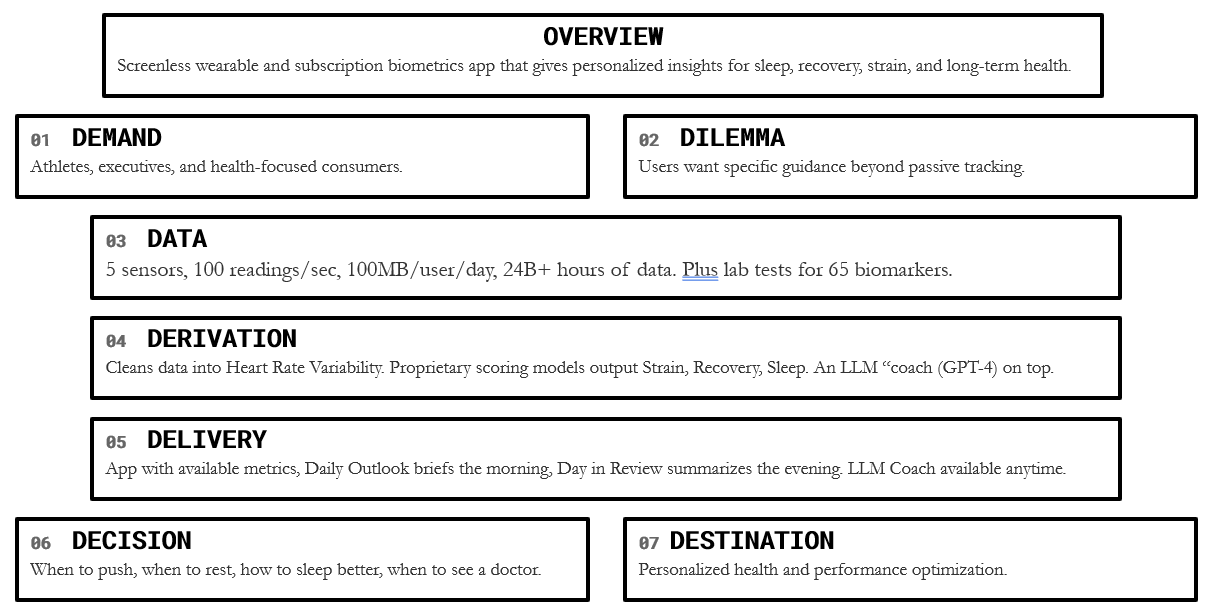
Demand: Athletes, executives, and health-curious consumers.
Dilemma: A desire to maximize performance.
Data: Five sensors, 100 readings/second, 100MB per user per day, 24 billion hours of physiological data, plus journal entries and lab biomarkers.
Derivation: Cleaning data into metrics like HRV. Proprietary scoring models compress the day into Strain, Recovery, Sleep. A LLM-based Coach (GPT-4) adds the conversational layer.
Delivery: A screenless band you never take off, plus an app that briefs you in the morning and gives recaps at night.
Decision: When to push, when to rest, when to sleep, when to see a doctor.
Destination: Personalized health and performance optimization.
WHOOP OVERVIEW
Date of Founding: 2012, at the Harvard Innovation Labs.11
CEO Profile
Will Ahmed grew up on Long Island. Egyptian-American. Captained the men’s squash team at Harvard. Graduated 2012 with an A.B. in government.12 He sits on the Board of Fellows of Harvard Medical School. Has meditated 20 minutes a day for eight years.
Founding Story
Ahmed was overtraining as a squash player—pushing hard, getting fitter, then suddenly hit a wall and didn’t understand why. He wrote an academic paper on continuously measuring the human body, and turned that into a business plan. He founded WHOOP in 2012 with John Capodilupo (engineering) and Aurelian Nicolae (mechanical). Their strategy was to start with elite athletes—Michael Phelps, LeBron James—whose fame would jumpstart the brand. The first commercial WHOOP shipped in 2015.
Funding History
$958 million total across nine rounds. Most recent: $575M Series G, March 2026, $10.1B valuation. Led by Collaborative Fund. Strategic investors: Abbott Laboratories and Mayo Clinic. Other institutional money: Qatar Investment Authority, Mubadala, IVP, Foundry, Accomplice. Athletes: Cristiano Ronaldo (also global ambassador), LeBron James, Rory McIlroy, Niall Horan, Reggie Miller. SoftBank put in $200M in 2021 at a $3.6B valuation.
What the Company Does
WHOOP sells a fabric strap with five sensors that’s worn 24/7 and can even embed in clothing. The wireless charger snaps onto the band so it never has to come off—which removes the most common reason people abandon wearables.11 The data flows to an app showing three core scores: Strain, Recovery, and Sleep (more on these and other metrics, below).
How the Company Makes Money
They sell annual subscriptions from $199/year to $359/year. After the initial 12-month commitment, members can switch to monthly ($25–$40). Hardware is essentially free; free upgrades to new devices come with active membership. Members who lapse lose app access; the device stops tracking. WHOOP Unite (B2B) sells aggregated wellness analytics to corporations and military organizations. They hit a $1B revenue run rate at end of 2025. 2.5M members globally.
Top Named Clients
Athletes: Cristiano Ronaldo, LeBron James, Michael Phelps, Patrick Mahomes, Virat Kohli, Rory McIlroy, Tiger Woods, Justin Thomas, Nelly Korda. Crown Prince of Dubai posts his recovery scores on Instagram. Team partnerships: Ferrari F1 (announced January 2026), Paris Saint-Germain through 2029, the PGA Tour, the WTA, MLB.1129
DIAGRAM
The DataStory’s own 7 D’s framework, applied to WHOOP.
1. DEMAND
Who is their user?
Priority User 1: The Performance Athlete.
Athletes either paid (NFL, PGA Tour, Premier League) or personal (CrossFit athletes, marathoners, cyclists). They worry about overtraining and injury.
Priority User 2: The Health-Focused Executive.
Late 30s to 50s, busy professional, often a CEO. Sleep is irregular. Travel disrupts everything. They are high-octane enough to think of their performance as something to be professionally optimized.
Priority User 3: The Health-Curious Consumer (newer cohort).
Especially women. Female members were up 150% YoY in early 2026 and engage with WHOOP AI ~30% more than men. Interested in sleep, hormonal cycle, stress, and long-term healthspan. WHOOP launched a Women’s Health Specialized Blood Biomarker Panel specifically for this group. Strangely no mention of a hypochondriac segment.
2. DILEMMA
What makes achieving that goal difficult?
Most users in these segments already own a wearable—an Apple Watch, Fitbit, Garmin, or Oura. The challenge WHOOP addresses is collecting biometric data and then turning it into useful guidance for the individual.
The Athlete.
Trains year-round and wants to know whether to push hard or take a recovery day.
The Executive.
Travels frequently and sleeps irregularly. Their need is to make personal changes around travel, alcohol, or workload, and get guidance.
The Health-Curious Consumer.
Often a woman. Most wearables were originally designed around male athletic-performance metrics and don’t take into consideration effects of the menstrual cycle, perimenopause, and pregnancy.
3. DATA
What data can be accessed to achieve the goal?
Five sensors gather 100 measurements per second, totalling 100 megabytes of data per user per day—roughly the equivalent of streaming 25 minutes of Netflix every day from your wrist. (What do you call that movie—Inside Out?) Across its user base, WHOOP claims to have accumulated 24 billion hours of physiological data. That is the dataset that Abbott and Mayo Clinic invested in. The data flows from four pipelines:
Data Type 1: Photoplethysmography (PPG) heart rate data.
PPG = shining light into the skin and measuring how much reflects back. As blood pumps through the wrist, blood volume under the sensor changes with each heartbeat, and the reflected light changes with it. From these signals, WHOOP derives heart rate and heart rate variability (HRV)—the small variations in time between consecutive heartbeats, which is interpreted in multiple ways.
Data Type 2: Motion, temperature, and ambient light.
Accelerometers measure user movement.
Skin temperature sensors measure sleep (temp drops slightly in deep sleep) and illness or menstruation (temp rises slightly).
Ambient light sensors check the physical context of the user (dark bedroom vs. sunlit room).
Data Type 3: User Journal and behavioral data.
WHOOP asks users to enter 30 seconds of context per day: alcohol, caffeine, late meal, meditation, screen time before bed, travel, illness. By correlating journal entries with biometric outcomes—“what happens to your recovery on days you drink alcohol?”—WHOOP can interpret the sensor info, or at least have a hypothesis to work from.
Data Type 4: Lab biomarkers (Advanced Labs).
Users can order actual blood panels in the app. Reminiscent of crazy Theranos, I know—note that the wearable doesn’t claim to prick the skin and administer the test itself. The service sets up the user with a Quest Diagnostics appointment, and results come back into the app. A standard panel might include 65 biomarkers including vitamin D, cholesterol, glucose, hormones, inflammation. A Women’s Health Panel launched in April 2026 focused on hormonal markers.
4. DERIVATION
How do analytics/AI make the data usable?
Three layers very similar to our Analytics Pyramid: Layer 1 makes the raw data usable. Layer 2 compresses it into scores. Layer 3 turns the numbers into a conversation
Layer 1: Signal processing and sleep staging.
Sleep stage measurement is inferred from continuous PPG, motion, and temperature… to classify each 30-second window as REM, deep, light, or awake.
Layer 2: Proprietary scoring models (Strain, Recovery, Sleep).
“Strain” is a 0–21 score representing the intensity of heart rate over 24 hours, weighted by the duration of that intensity. The 0–21 scale echoes the “Borg scale of perceived exertion,” which sounds like a magic item from Dungeons & Dragons, but is instead a sports science metric developed in the 1960s.
“Recovery” comes from three primary inputs: HRV during the previous night’s sleep, resting heart rate, and the amount of time the user spent in restorative sleep stages. Then the user gets a traffic light: Green (67%+) = ready to rock. Yellow (34–66%) = moderate effort. Red (0–33%) = rest day.
Sleep is a 0–100% score derived from a model that personalizes recommendations to the individual based on the day’s strain, prior sleep debt, and naps. The output is a specific recommended bedtime. Naps, bedtime… this is my kind of app.
Layer 3: WHOOP Coach (generative AI on OpenAI GPT-4).
This layers conversational AI on top of the data. The member asks: “why is my recovery low this week?” The system pulls relevant data and sends it (the company claims, anonymized) along with the question to an LLM partner. (According to my sandwich framework, WHOOP is a bread company.) The returning answer combines the LLM’s general knowledge (of physiology in this case) with the user’s specific data points, and produces a personalized answer in plain language.
Also, the user gets a “Daily Outlook” each morning and “Day in Review” in the evening.
Lastly, the company uses AI to estimate physiological age (as opposed to chronological age). They do this based on nine biomarkers: heart rate zones, sleep consistency, VO2 max, lean body mass, others.
5. DELIVERY
How does the workflow improve for the user?
Hardware
The band is engineered for 24/7 wear that’s pure measurement, no engagement at all. The wireless power source snaps onto the band so members charge it without taking off the band itself.
Software
Daily rhythm:
Morning. The user opens the app, sees Recovery score. Daily Outlook briefs them on the day ahead based on Recovery, schedule, training goals.
During the day. The strain target displays on the home screen. The app prompts the user to confirm activity (run, lift, yoga) so the algorithm attributes heart rate spikes correctly.
Evening. Day in Review: strain, sleep, behaviors. The user logs Journal entries (alcohol, caffeine, etc.). Then the Sleep Need calculation outputs a recommended bedtime.
Anytime. The WHOOP Coach is available for ad-hoc questions.
6. DECISION
What decision is enabled by using the data?
WHOOP enables lots of small daily decisions but cumulatively, you can see how they add up.
Training. Hard workout today, or easy day?
Sleep. What time should I go to bed?
Behavior. Another glass of wine?
Health. Should I see a doctor? WHOOP’s respiratory-rate algorithm flagged early COVID-19 cases, and crazily, is documented in academic literature.
7. DESTINATION
What does success look like?
For the health-conscious consumer, the exec, the athlete, interacting with a smart device—especially one tuned their bodies—is about optimization.
Which is strange to say when you come from adtech—a multi-hundred-billion-dollar industry built by the largest tech companies in the world—focused on getting people to click ads. This is optimization of health, performance, even longevity.
Just as ad-tech-ers create a closed loop between ad exposure, ad impact, and action taken on an ad campaign (shift impressions to gaming apps!), WHOOP creates a loop between biometrics and actions… decisions… the user can take.
Although arguably the device industry is still missing a slice—namely, the actual outcome. Was the executive more effective when they went to bed at 10:38pm? Was the user healthier when they detected they had Covid (maybe that one’s obvious)? Was the athlete able to achieve greater personal records? (Although atheletes can log performance over time, so it can be seen in trends.) The biometrics are—by my take—proxies.
But in any case, the wonder of this space, I believe, is the personalized feedback loop: feeding you back data on your own body in real time, and interpreting it for decisions. Our bodies already provide this information in the form of mood and a million other nuanced signals—says the MBA who hasn’t taken a biology class since 12th grade AP Bio—but not with explanation. With these devices, you can filter the signals through algos designed by people who did take bio in college and get informed counsel. To optimize your health all around.
8. GLOSSARY
Heart Rate Variability (HRV): Small variations in time between consecutive heartbeats.
Photoplethysmography (PPG): Measures blood flow by shining light into the skin and detecting how much reflects back.
Strain (WHOOP-specific): 0–21 score for 24-hour cardiovascular load—heart rate intensity weighted by duration.
Recovery (WHOOP-specific): 0–100% score, calculated each morning. Built from HRV during slow-wave sleep, resting heart rate, and restorative sleep time.
Polysomnography (PSG): The standard sleep test. Electrodes attached to scalp, face, chest. Measures brain waves, eye movement, muscle tone, breathing.
Healthspan (WHOOP-specific): Estimates physiological age from nine biomarkers (heart rate zones, sleep consistency, VO2 max, lean body mass, etc.). Distinct from chronological age.
Advanced Labs (WHOOP-specific): The company’s blood biomarker testing program (launched 2025, U.S. only).
Hardware-as-a-Service (HaaS): Physical hardware delivered through recurring subscription, not one-time sale.
9. NOTES & SOURCES
1. Connie Loizos, “Whoop’s valuation just tripled to $10 billion,” TechCrunch, March 31, 2026. https://techcrunch.com/2026/03/31/whoop-valuation-10b-series-g-fundraise/
2. “Whoop Raises $575 Million at $10 Billion Valuation on Its Way to an IPO,” Bloomberg, March 31, 2026. https://www.bloomberg.com/news/articles/2026-03-31/whoop-raises-575-million-at-a-10-billion-valuation-on-its-way-to-an-ipo
3. WHOOP, “WHOOP Raises $575 Million at $10.1 Billion Valuation,” Press Center, March 31, 2026. https://www.whoop.com/us/en/press-center/whoop-announces-series-g-funding/
4. Collaborative Fund, “WHOOP” investment letter, March 31, 2026. https://collabfund.com/blog/whoop/
5. Elise Reuter, “Whoop raises $575M, adds Abbott as strategic investor,” MedTech Dive, March 31, 2026. https://www.medtechdive.com/news/whoop-raises-575m-adds-abbott-as-strategic-investor/816229/
6. “Whoop raises $575M—Abbott, LeBron James, Cristiano Ronaldo among the investors,” Cardiovascular Business, March 31, 2026. https://cardiovascularbusiness.com/topics/healthcare-management/healthcare-economics/whoop-raises-575m-abbott-lebron-james-cristiano-ronaldo-among-investors
7. Blythe Karow, “A Proclamation on the Future of Wearables: The Real Reasons Abbott and Mayo Invested in WHOOP,” Substack, April 2026. https://blythekarow.substack.com/p/a-proclamation-on-the-future-of-wearables
8. “Whoop raises $575M series G, Abbott comes on board amid hiring spree,” Fierce Biotech, April 1, 2026. https://www.fiercebiotech.com/medtech/whoop-raises-575m-series-g-abbott-comes-board-amid-hiring-spree
9. “Whoop concludes $575m fundraise, adding Abbott as strategic investor,” Medical Device Network / GlobalData, April 1, 2026. https://finance.yahoo.com/sectors/healthcare/articles/whoop-concludes-575m-fundraise-adding-104744037.html
10. “Whoop Raises $575 Mn Series G, Abbott Joins as FDA Eases Regulatory Path,” Digital Health News, April 2, 2026. https://www.digitalhealthnews.com/whoop-raises-575-mn-series-g-abbott-joins-as-fda-eases-regulatory-path
11. “Whoop (company),” Wikipedia, accessed May 2026. https://en.wikipedia.org/wiki/Whoop_(company)
12. “Will Ahmed,” Wikipedia, accessed May 2026. https://en.wikipedia.org/wiki/Will_Ahmed
13. WHOOP, “About Us.” https://www.whoop.com/us/en/about/
14. Harvard SEAS, “How WHOOP founder Will Ahmed found his voice as an entrepreneur,” September 23, 2024. https://seas.harvard.edu/news/how-whoop-founder-will-ahmed-found-his-voice-entrepreneur
15. WHOOP, “Membership Options | Compare Plans & Features.” https://www.whoop.com/us/en/membership/
16. PriceTimeline, “WHOOP Membership Pricing Changes,” updated September 25, 2025. https://pricetimeline.com/data/price/whoop-membership
17. Bellenger CR, et al., “Wrist-Based Photoplethysmography Assessment of Heart Rate and Heart Rate Variability: Validation of WHOOP,” Sensors (Basel), May 20, 2021. https://www.mdpi.com/1424-8220/21/10/3571
18. WHOOP, “WHOOP Proven Most Accurate Wearable in Heart Rate & HRV Measurements,” October 27, 2022. https://www.whoop.com/us/en/thelocker/whoop-proven-most-accurate-wearable-in-heart-rate-heart-rate-variability-measurements/
19. “WHOOP App Features Tested,” Liveworksleep, February 27, 2026. https://liveworksleep.com/whoop-app-features/
20. WHOOP, “WHOOP Unveils the New WHOOP Coach Powered by OpenAI,” BusinessWire, September 26, 2023. https://www.businesswire.com/news/home/20230926899032/en/
21. WHOOP, “New AI guidance from WHOOP connects every part of your health,” October 16, 2025. https://www.whoop.com/us/en/thelocker/new-ai-guidance-from-whoop/
22. Rolls Performance Lab, “WHOOP 5.0 & WHOOP MG: AI-Powered Performance, Recovery, and Health Optimization Explained,” May 25, 2025. https://www.rollsperformancelab.com/news-and-articles-1/whoop-launches-5
23. “What’s Behind Whoop’s Soaring $10 Billion Valuation,” Kavout Market Lens, April 2026. https://www.kavout.com/market-lens/what-s-behind-whoop-s-soaring-10-billion-valuation
24. “Case Study: Whoop Business Strategy & Device-as-a-Service Success,” Circuly, January 27, 2026. https://www.circuly.io/blog/case-study-whoop-business-strategy-device-as-a-service-success
25. “Whoop revenue, valuation & funding,” Sacra, March 21, 2026. https://sacra.com/c/whoop/
26. WHOOP partnered with Central Queensland University researchers to validate its COVID-19 detection algorithm; identified 80% of positive cases by day three of symptoms. See “Whoop (company),” Wikipedia.
27. WHOOP, Advanced Labs and Healthspan product information. https://www.whoop.com/
29. WHOOP became the official health and fitness wearable partner of Ferrari Formula One team, January 2026. See “Whoop (company),” Wikipedia.
30. Apple Watch and Fitbit/Pixel Watch irregular rhythm notifications now constitute the largest deployed cardiac screening tool in human history. See Apple Heart Study and FDA AI/ML clearance database.
31. Samsung Galaxy Watch (February 2024) and Apple Watch (September 2024) received FDA approval for sleep apnea / breathing disturbance detection. Roughly 25M American adults have OSA, the majority undiagnosed. https://www.apple.com/newsroom/
32. FDA, “FDA Clears First Over-the-Counter Continuous Glucose Monitor” (Dexcom Stelo), March 2024. https://www.fda.gov/news-events/press-announcements/fda-clears-first-over-counter-continuous-glucose-monitor
33. Apple, “Apple introduces groundbreaking health features” — AirPods Pro 2 with iOS 18 hearing aid feature, September 2024. https://www.apple.com/newsroom/2024/09/apple-introduces-groundbreaking-health-features/
34. Mediwhale’s Reti-CVD and Reti-CKD use machine learning on retinal images to predict cardiovascular and kidney disease. https://www.mediwhale.com/
35. FDA, “Artificial Intelligence and Machine Learning (AI/ML)-Enabled Medical Devices.” 295 clearances in 2025. https://www.fda.gov/medical-devices/software-medical-device-samd/artificial-intelligence-and-machine-learning-aiml-enabled-medical-devices
38. DemandSage / Counterpoint Research, “Smartwatch Statistics 2026: Global Users & Market Share.” 562.86M smartwatch users worldwide; market valued $35.29B; Apple holds 23% market share. https://www.demandsage.com/smartwatch-statistics/
39. SQ Magazine, “Apple Statistics 2026.” Apple Watch active users surpassed 170M with 92% retention; 54M units shipped in 2025; Apple Watch health features triggered 45,000+ emergency calls. Cf. Above Avalon (Neil Cybart) estimate of 200M+ Apple Watch installed base. https://sqmagazine.co.uk/apple-statistics/
40. “Apple Q4: Why Wearables Revenue Declined Despite Record User Growth,” the5krunner, October 30, 2025. Apple Watch active installed base at all-time high; 95% U.S. customer satisfaction; half of Q4 buyers were new to the product. https://the5krunner.com/2025/10/30/apple-q4-apple-watch-revenue-new-users/
41. “How many active Garmin Connect users are there in 2026?” the5krunner, May 1, 2026. Garmin shipped ~320M products since 1989; record 20M+ units in 2025; Q4 2025 fitness revenue +42% YoY. https://the5krunner.com/2026/05/01/garmin-connect-users-2026/
42. Business of Apps, “Fitbit Revenue and Usage Statistics (2026),” March 9, 2026. ~33M monthly active users; 137M registered users; 4.3M units sold in 2025 (down 21.8% YoY); Fitbit Premium ~2.2M paying subscribers. https://www.businessofapps.com/data/fitbit-statistics/
43. Oura press release, “Oura Surpasses 5.5 Million Rings Sold,” BusinessWire, September 22, 2025. 5.5M rings sold cumulatively; ~3M sold in 2025 alone; ~2M paying subscribers; $1B revenue run rate. https://www.businesswire.com/news/home/20250922351288/
44. IDC research, cited in Sherin Shibu, “Smart Ring Maker Oura Expects Sales to Grow to $2B Next Year,” Entrepreneur, November 11, 2025. Oura holds ~80% of global smart ring market. https://www.entrepreneur.com/business-news/smart-ring-maker-oura-expects-sales-to-grow-to-2b-next-year/499465