

SPOILER ALERT: AFRESH CASE STUDY
Or, How to Save 500 Billion Bananas with Data

EDITOR’S NOTE
Several times a month we deep-dive into a company that just raised money and we pull it apart with our “7Ds” framework to see exactly how it uses data and AI—and what you can learn from it. This week: Afresh, a San Francisco company that raised $34 million on April 21st to use AI in the grocery store “fresh” (think perishables) department.
US food waste is 147 billion pounds of food per year.
We found the combination of data, AI, rotten meat and bruised peaches to be an irresistible combination. And also, the great data challenge of calibrating something as ephemeral as lettuce on a store shelf.
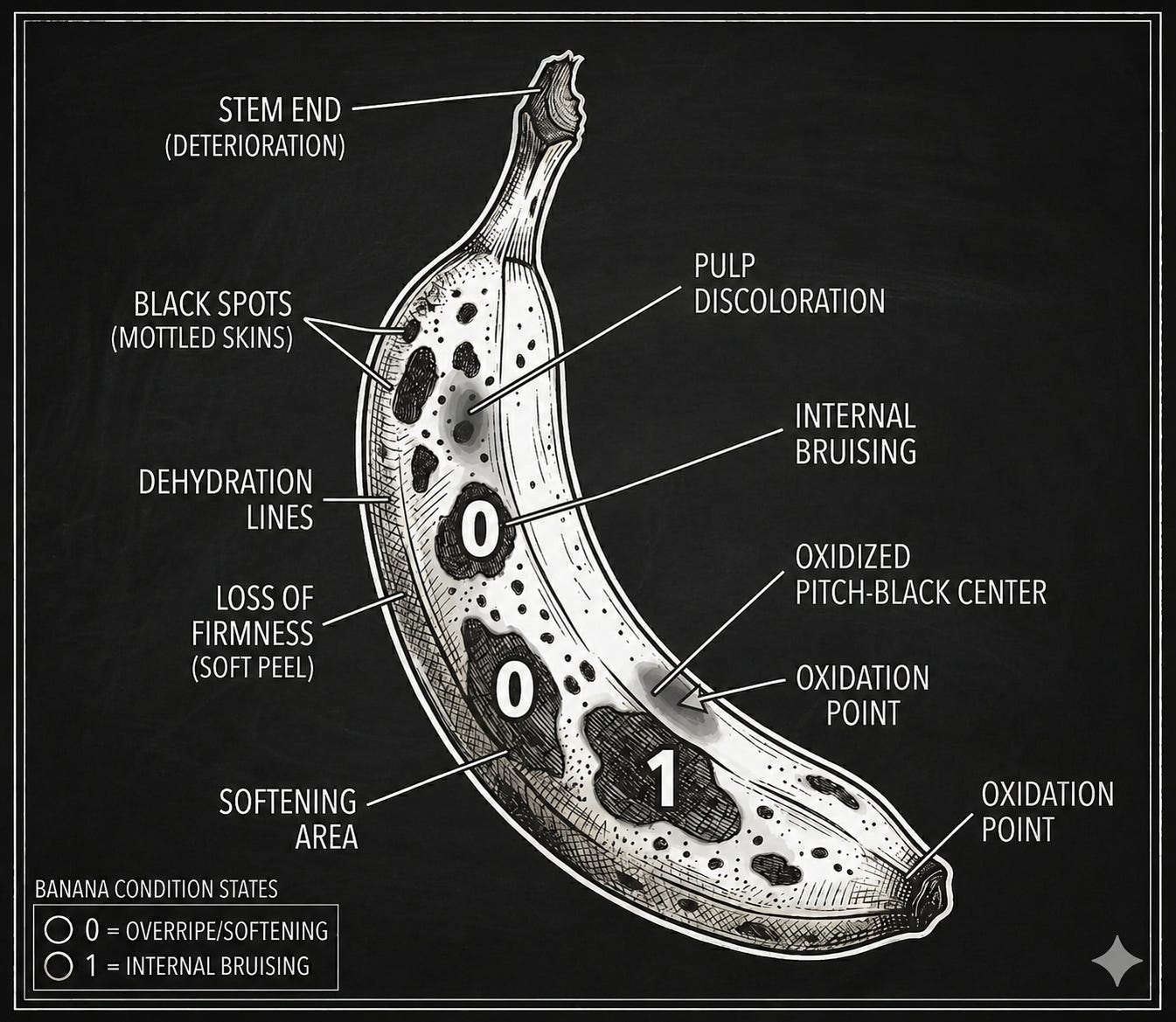
BANANAS, BANANAS
The US grocery business is pretty enormous. We have 45,000 supermarkets in the US, and about 40% of the business, in dollars, is perishables. Those supermarkets (and other formats) together sell about $487B in perishables… but here’s the thing. We throw away 147 billion pounds of food every year, which is about 30% of all the food we make.
In weight, that’s the equivalent of 500 billion bananas.
It means every American is throwing away 2.3x their body weight in food every year. Which is nearly 100% more than what Mexico dumps on a per-capita basis, and (of course) almost 2x what they flush in France.
When you put that in the context of grocery store margins--notoriously slim; The Food Industry Association puts the industry’s net profit margin at 1.7%--you see why food waste is a big deal. (It’s sometimes called “shrinkage” or “shrink” in the industry, a term that includes theft and other mishaps) A few points of spoilage can flip a store from profitable to losing money.
So that’s bad; lost profit. But there’s a darker angle. Only 2% of surplus food is donated (according a report by nonprofit ReFED.) About 85% rots in the field unharvested or ends up in compost or landfills… meanwhile, 47.4 million Americans--about 13.5% of households, including 14 million children--live in food-insecure homes (USDA). The food bank and pantry system led by an organization called Feeding America supports a network of more than 200 food banks and 60,000 pantries, which scoops up over 4 billion pounds of food a year… yet it still cannot close the gap.
One last cost to society: if you throw away 500 billion bananas… all the water you used to grow them.. the labor you used to plant and pick them… the gas (and pollution) you used to ship them… was also, all waste.
Meanwhile 47 million Americans are food insecure.
All told, we grow plenty of food for all. But we lose about a third of it between farm and fork. So anything that keeps good food in circulation… to be sold or donated… chips away at both problems.
Enter our company of the week, Afresh.
HOW DO YOU GET DATA ON A PEACH?
Why is fresh so wasteful? Because it is the hardest thing in the store to predict. A can of clam chowder is good for two years; a clamshell of strawberries lasts mere days. Demand swings with the weather, the holidays, the weekend forecast.
Our readers know that if prediction is the problem, then data is likely the solution. Yet accurate data on fresh food is devilishly hard to procure. A barcode-scanned box of cereal leaves a clean digital trail; a bruise-y peach gets quietly tossed, and that info never touches a data-gathering system.
Afresh, Invafresh, Freshflow…
this sector needs a naming consultant!
One part of Afresh’s job, then, is making data that does not otherwise exist: getting store associates to count fresh inventory through an app. Then they combine it with the retailer’s own data.
They use this data for a pretty simple set of predictions and decisions: net of spoilage, what inventory will I have on a daily basis; and--again net of anticipated spoilage--what should I order, so I don’t over or under-order?
The company says their software now runs in more than 12,500 departments across 40 states, and that 2025 revenue grew 70% year over year. Investors include Spark Capital, Insight Partners, Innovation Endeavors, Maersk Growth, and, in the latest round, Just Climate and High Sage Ventures.
Afresh is not alone. There’s Shelf Engine (automates ordering of perishables); Invafresh (cloud software for fresh merchandising and replenishment); Freshflow and Aravita (both pitch AI order forecasting). While the sector might need some naming consulting, it’s projected to boom nonetheless: AI in food retail generally is projected to grow from $2.7 billion in 2024 to $13.4 billion by 2030.
WHAT IT MEANS FOR YOU
Look for your own “latent data.” Afresh uses Point of Sales (POS) product scans, and store delivery records… data that was already there… to feed new models. What transaction or operational data are you already collecting and ignoring?
Find the place where people still use a clipboard. As you’ll see in the origin story below, the Afresh founders saw a grocery store manager’s handwritten food order guide, and knew there was a gap to fill. Where in your operation are high-dollar decisions still made on memory, guessing, scribbled notes?
When the data does not exist, consider gathering it. Afresh built a food counting app that seems to be pretty efficient, even if it’s gathered by store employees. Is there a critical input you would have to create from scratch--but where owning that data would open new possibilities? Remember, the data asset--even if it expires at the end of the week like in a lettuce section--is still valuable for the future because it’s predictive.
Keep a human in the loop. Afresh recommends order sizes; an associate confirms them--or overrides them. Which decisions should stay a recommendation for a person to sign off on, vs. become (or remain) fully automated?
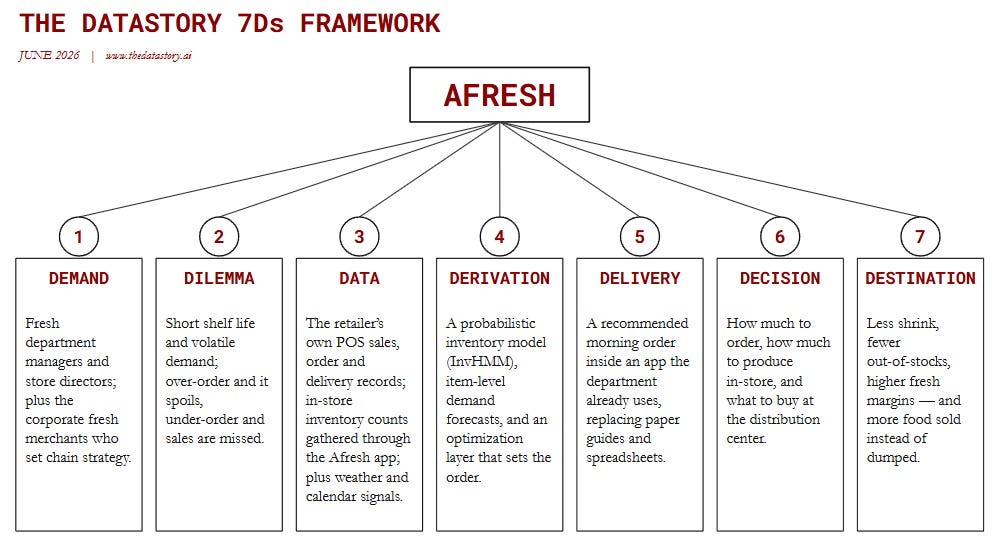
THE 7Ds OF DATA INNOVATION FOR AFRESH
COMPANY OVERVIEW
Afresh builds software that tells grocery stores how much fresh food to order, make, and stock. Its AI reads a store’s sales, deliveries, and inventory, and produces an item-by-item order recommendation for perishable departments--produce, meat, seafood, deli, bakery--and, increasingly, for the rest of the store.
Date of Founding: 2017. Headquartered in San Francisco.
CEO / Founder Profile: Matt Schwartz, the CEO, came to the problem through food and sustainability rather than retail. He and co-founder Nathan Fenner met at Stanford’s Graduate School of Business, where Fenner brought an engineering background and Schwartz was researching how to build a more sustainable food system. Schwartz’s stated view is that fixing the food system is the single smartest way to improve human and environmental health.
Founding Story: In their second year of business school, Schwartz and Fenner ran an independent study on the fresh food supply chain, working from a thesis that fresh was the future of grocery yet barely touched by modern technology. To test it, they walked into a local grocery store. The produce section was out of stock on a lot of items. They found the department manager, who showed them how he ordered: paper, filled in by hand each day, for hundreds of items, equating to millions of dollars of product per year at a multi-billion-dollar chain. They founded Afresh in 2017; co-founders also include Volodymyr Kuleshov and Sha Sebastian.
Total Investment Raised: Afresh raised a $12 million Series A in July 2020 (led by Food Retail Ventures, with Innovation Endeavors, Maersk Growth, and Baseline Ventures), then a $115 million Series B in August 2022 that the company said brought total funding to $148 million. In April 2026 it added $34 million co-led by Just Climate--the climate fund of Generation Investment Management--and High Sage Ventures.
What the Company Does: The platform now includes six products. The core is store-level ordering: each morning it hands a department manager a recommended order for every item. In addition there is inventory management, in-store production planning (how many rotisserie chickens or muffins to make), and distribution-center forecasting (what the warehouse should buy). Afresh has pushed beyond fresh into center store, frozen, and general merchandise. It does this without dedicated hardware or shelf cameras--no robots, no fixed sensors--relying on the retailer’s data and counts entered by associates.
How the Company Makes Money: Afresh sells enterprise software to grocery retailers, generally as a subscription priced by the number of stores and departments deployed; exact pricing is not public.
Top Named Clients: Albertsons (a chainwide deployment across its banners, tied to a goal of cutting food waste 50% by 2030), WinCo Foods, Heinen’s, Save Mart, Bashas’, Cub Foods, Stater Bros., Meijer, Wakefern, and Fresh Thyme.
DETAIL - THE 7Ds OF DATA INNOVATION
1. DEMAND — “Who is their user?”
The Fresh Department Manager. The produce, meat, or deli manager who runs one perishable section of one store. Often a long-tenured, first-line employee, close to the floor, who knows the regulars and the rhythm of the week. They are rewarded based on in-stock levels, shrinkage, and how the department looks (full shelves, nothing rotting). Their day starts early, walking the section, eyeballing what’s left, judging what will sell, and placing their orders.
The Store Director. The person accountable for the whole store’s profit and loss, measured on total shrinkage, labor, and of course sales. They juggle dozens of departments, and fresh is the riskiest one on the floor.
The Corporate Fresh Merchant. The chain-level category leader who sets assortment (grocery word for the menu of food you sell). They want item-level visibility across hundreds of stores at once. They also own public sustainability targets--like that Albertsons committment to cutting food waste 50% by 2030, which has made them a USDA Food Loss and Waste Champion.
2. DILEMMA — “What makes the goal difficult?”
For the department manager, fresh ordering is tricky: over-order and it spoils within days; under-order and the shelf is empty by afternoon meaning missed sales and sniffy customers. There’s also complexity: a single section can carry hundreds of items, each with its own shelf life and demand curve; shrinkage for fresh fruit runs from 4% for bananas 40%+ for other items. The order tends to get placed under time pressure, with deliveries running on fixed schedules.
For the store director, spoilage hits that 1.7% margin, on top of the labor cost and tedium of counting fresh produce by hand. High employee turnover means the institutional knowledge of “how much we usually sell” walks out the door with every departure.
For the corporate merchant, there is no item-level visibility of stock and shrinkage across stores, making it harder to hit goals.
3. DATA — “What data can be accessed?”
Afresh runs almost entirely on data the retailer already produces--plus inventory counts that it captures in-store. Partners send their existing files to Afresh’s Azure-based cloud; Afresh builds a custom transformation layer for each feed that maps the raw fields to its internal schema, so the grocer doesn’t need to set up new tools or file formats.
Onboarding is a one-time transfer of historical data, then a daily transfer of fresh inputs. Four data sources feed the platform:
POS sales history. Item-level scan data from the checkout. This includes each SKU, how many units sold, date, and price, including promotions and markdowns. It comes from the chain’s existing POS system (Afresh uses the current feed and is POS-agnostic). It’s delivered first as a multi-year historical extract, then is refreshed daily.
Inventory counts. On-hand quantity for each fresh item. Most systems never record this for fresh, so Afresh generates it. Store associates count all the items in a department using the Afresh app--the virtues of which is that is supports several people counting at once to get it done quickly. It also flags a suspected misscan or off-entry as it is typed. Counts feed the inventory model and are validated by corporate through a web portal. Example: a clerk enters 200 cases of strawberries, the app sees that this is 10x the usual count and recent sales, and flags it.
Supply-chain and ordering records. Purchase orders, delivery schedules, shipment fill rates (how much of an order the vendor or distribution center actually shipped), vendor lead times, order guides (client-specific product menus), and the inventory in the data center. These come from the retailer’s ERP and warehouse management system (WMS). Afresh clusters ERP, WMS, and POS records for the same product into one entity, so an item is recognized once and tracked through each form it takes--by the case, by the item, or by weight. Afresh reconciles mismatched SKUs, units of measure, and shelf lives across the systems. Product attributes like pack size are drawn from the retailer’s item master.
External signals. External calendar data (day of week, holidays) and weather, that tell you a holiday weekend, and a warm forecast, might predict a berry spike that the trend from prior weeks of sales alone might miss.
4. DERIVATION — “How do analytics and AI make the data usable?”
Afresh applies machine learning across three layers:
Inventory estimation. The actual counts for produce shift around because spoilage, miscounts, and misscans go unrecorded. The company uses a hidden Markov model (the second appearance of this model in a DataStory newsletter in two weeks!) to estimate a hidden state--true inventory--from observed signals such as sales, deliveries, and periodic manual counts. For example Monday’s count is 10 units and Tuesday’s delivery adds 5, so true Tuesday inventory falls between 0 and 15; the model assigns a probability to each value using forecasted sales, shipment fill rates, and spoilage rates… then recalibrates against the next physical count. The output is an estimated actual, on-hand quantity, with an uncertainty range, for every item, each day.
Demand forecasting. An item-level, store-level, daily prediction of units that will sell, conditioned on price, promotions, perishability, seasonality, and weather. The model returns a forecast plus a confidence range so a volatile item (such as berries for pie before July 4) is handled differently from a steady seller like bagged carrots.
Order optimization. A decision engine converts the inventory estimate and demand forecast into a recommended order quantity per item. It also factors in the cost of a stockout vs. the cost of spoilage, optimizing for margin. It can simulate scenarios--like a different delivery day--before making recommendations. Afresh reports managers accept the recommended order, as-is, 97% of the time.
5. DELIVERY — “How does the workflow improve?”
The product lives in an app the department already uses. It’s scheduled into the morning ordering routine. Where the manager used to walk the aisle and make guesses, then hand-write an order guide, they now open the app to a recommended order, adjust the few things they know better than the model, and submit. It replaces paper order guides, spreadsheets, and end-of-day manual counts.
There’s also a web portal for the corporate team.
6. DECISION — “What decision is enabled?”
The platform affects three decisions:
How much to order. The daily question for every item, answered with a number instead of a guess. Customers report out-of-stocks down as much as 80%.
How much to produce. For in-store kitchens and bakeries, how many units to make so you don’t sell out; or end up dumping all the donuts at closing.
What to buy upstream. At the distribution center, how much to stock and ship so stores are covered. Also avoid warehouse spoilage.
According to the company, clients running on Afresh report food waste down 25% or more, produce operating margins up over 40%, inventory turns up about 7%, and roughly 31% less time spent taking inventory.
7. DESTINATION — “What does success look like?”
Afresh has helped its customers arrive when the fresh department isn’t wilty; it’s full but not overstocked; and less food ends up in the dumpster. This helps customers get all the items from their shopping list; the stores and chains grow revenue and margin; and broadly, we have a healthier food system.
SOURCES
Company, funding, and clients
Afresh, “Afresh Raises $34M to Scale AI Across the Grocery Industry,” PR Newswire, April 21, 2026. https://www.prnewswire.com/news-releases/afresh-raises-34m-to-scale-ai-across-the-grocery-industry--driving-fresher-food-stronger-margins-and-less-waste-302747794.html
Afresh, “Afresh Secures $115 Million in Series B Funding,” PR Newswire, August 4, 2022. https://www.prnewswire.com/news-releases/afresh-secures-115-million-in-series-b-funding-and-rolls-out-its-fresh-food-technology-to-thousands-of-stores-across-the-us-301598519.html
Innovation Endeavors, “Meet Super Evolution drivers Nathan and Matt: Co-founders of Afresh.” https://www.innovationendeavors.com/insights/meet-super-evolution-drivers-nathan-and-matt-co-founders-of-afresh
Afresh, “Sharing Our $115M Series B — and Why We Started Afresh.” https://www.afresh.com/resources/sharing-our-115-million-series-b-and-why-we-started-afresh
Progressive Grocer, “Albertsons Cos. Opts for Afresh’s AI Platform.” https://progressivegrocer.com/albertsons-cos-opts-afreshs-ai-platform
Grocery Dive, “Albertsons to deploy AI-powered food waste-reduction tech chainwide.” https://www.grocerydive.com/news/albertsons-to-deploy-ai-powered-food-waste-reduction-tech-chainwide/617855/
Technology, data, and results
Afresh, “Accelerated time to value and low IT lift: the new standard for deploying fresh technology.” https://www.afresh.com/resources/accelerated-time-to-value-and-low-it-lift-the-new-standard-for-deploying-fresh-technology
Afresh, “Afresh’s Artificial Intelligence” (platform overview). https://www.afresh.com/platform/artificial-intelligence
Afresh, “The Future of Fresh Inventory: How Afresh’s Machine Learning Model is Reimagining Inventory Management.” https://www.afresh.com/resources/the-future-of-fresh-inventory-how-afreshs-machine-learning-model-is-reimagining-inventory-management
Aaron Stern, “Making it Count: Probabilistic Inventory in Grocery,” Afresh Engineering (Medium). https://medium.com/afresh-engineering/making-it-count-52c3b5b459c7
Afresh, “Afresh Adds Inventory Management Solution to AI-Powered Fresh Tech Platform.” https://www.afresh.com/resources/afresh-adds-inventory-management-solution-to-ai-powered-fresh-tech-platform
Supermarket News, “How Afresh is revolutionizing grocery perimeters with AI.” https://www.supermarketnews.com/grocery-technology/how-afresh-is-revolutionizing-grocery-perimeters-with-ai
Food waste, hunger, and grocery margins
ReFED, “Food Waste Data — Causes & Impacts.” https://refed.org/food-waste/the-problem/
ReFED, U.S. Food Waste Report 2025. https://refed.org/downloads/refed-us-food-waste-report-2025.pdf
USDA Economic Research Service, Food Availability (Per Capita) Data System — Food Loss. https://www.ers.usda.gov/data-products/food-availability-per-capita-data-system/food-loss
USDA, Food Waste FAQs. https://www.usda.gov/about-food/food-safety/food-loss-and-waste/food-waste-faqs
Feeding America, “Ten Ways Food Waste Hurts the Environment.” https://www.feedingamerica.org/hunger-blog/ten-ways-food-waste-hurts-the-environment
Food Industry Association (FMI), “Grocery Store Chains Net Profit.” https://www.fmi.org/our-research/food-industry-facts/grocery-store-chains-net-profit
Grocery Dive, “Grocery industry profit margins fall to pre-pandemic levels: FMI.” https://www.grocerydive.com/news/grocery-industry-profit-margins-fall-to-pre-pandemic-levels-fmi/720517/
Competitors and market
CB Insights, “Top Afresh Alternatives, Competitors.” https://www.cbinsights.com/company/afresh-technologies/alternatives-competitors
CB Insights, “Invafresh — Products, Competitors, Financials.” https://www.cbinsights.com/company/invatron-systems